Unit 1.2: IST & Time Lag Paradox
Indian Geography → Indian Geography → PHYSICAL FOUNDATIONS → PHYSICAL FOUNDATIONS → Location & Frontiers | Author: admin | Feb 11, 2026
1. Introduction & Significance Unit 1.2 (IST & Time Lag Paradox) is a foundational, high-scoring topic in UPSC Prelims (frequent MCQs on meridian, time difference, why single zone) and SSC/RRB/State PSC (factual recall on Mirzapur, sunrise variation). It links to practical geography (daily life, train timings) and current debates (proposals for multiple zones in NE). In 2026 exams, expect questions on administrative reasons for single IST and its real-world impact. This is a 4–6 mark Prelims certainty — nail the paradox and calculations for easy points.
2. Chronological/Geological Timeline
- Pre-1900s: Local solar time used; railway time based on Madras (Chennai) ~80°E.
- 1905: Viceroy Curzon proposes 82°30'E meridian near Mirzapur (central position).
- 1906: IST (UTC+5:30) introduced for uniformity.
- 1947: Independent India adopts IST officially as single time zone.
- 1950s–1990s: Calcutta/Bombay local times phased out completely.
- 2010s–2020s: Demands for separate zones (NE early sunrise, Gujarat late) rejected for national unity.
- 2025–2026: Draft Legal Metrology (IST) Rules reinforce standardization (CSIR-NPL maintains accuracy).
3. Concept Deep Dive India spans ~29° longitude (68°7'E to 97°25'E). Earth rotates 360° in 24 hours ? 15° per hour ? 1° = 4 minutes. Thus, ~29° = ~116 minutes (~2 hours) difference in local solar time between extremes. Eastern Arunachal has sunrise ~2 hours earlier than western Gujarat based on local sun position. To prevent confusion (e.g., different work/school times), India adopts single IST at central 82°30'E meridian (Mirzapur, UP) ? UTC+5:30. This creates paradox: clocks same nationwide, but actual daylight varies (NE wakes earlier, west sleeps later). No daylight saving or multiple zones due to unity, railway uniformity, and administrative ease. (Ref: NCERT Class 11 India Physical Environment Ch. 1; Goh Cheng Leong Ch. on Longitude & Time; Majid Husain Ch. 1 for Indian extent implications).
4. Key Terminology Box
- Indian Standard Time (IST): India's uniform time, UTC+5:30, based on 82°30'E meridian.
- Standard Meridian: Chosen longitude for national time reference (India: 82°30'E).
- Time Lag Paradox: Same clock time nationwide despite ~2-hour solar variation across extent.
- Local Solar Time: Time based on Sun's position at a location (varies by longitude).
- Time Zone: Region with uniform time; India has one despite span qualifying for two.
- Daylight Saving Time: Seasonal clock shift (not used in India).
- Mirzapur Meridian: 82°30'E line passing near Mirzapur (UP) for IST calculation.
- Longitudinal Time Difference: 4 minutes per 1° longitude.
5. Important Factual Details
| Parameter | Detail | Key Location / Note |
|---|---|---|
| Longitudinal Extent | 68°7'E – 97°25'E | ~29° span causes ~116–120 min difference |
| Time Lag Across India | ~2 hours (116–120 minutes) | Eastern sunrise earlier than western |
| Standard Meridian | 82°30'E | Central, passes near Mirzapur, UP |
| IST Offset | UTC + 5:30 | No adjustments (no DST) |
| Reference Town | Mirzapur (Uttar Pradesh) | Exact line for IST clocks |
| Eastern Sunrise Advantage | ~1–2 hours earlier than IST | Arunachal Pradesh (earliest) |
| Western Sunset Advantage | ~1 hour later than IST | Gujarat (latest) |
| Reason for Single Zone | Administrative uniformity, national unity | Avoids chaos in transport, communication |
6. Frequently Asked Exam Facts
- IST based on 82°30'E meridian (Mirzapur, UP).
- India has single time zone despite ~2-hour time lag.
- Time difference: ~2 hours between Gujarat and Arunachal Pradesh.
- Arunachal Pradesh: Earliest sunrise in India.
- Gujarat: Latest sunset in India.
- No daylight saving time observed in India.
- 1° longitude = 4 minutes time difference.
- IST = UTC + 5:30 (no half-hour like Nepal).
- Mirzapur chosen as central reference point.
- Paradox: Clocks same, but daylight varies east-west.
7. Comparison Charts/Tables
| Concept | India (Single IST) | Countries with Multiple Zones (e.g., USA) |
|---|---|---|
| Longitudinal Span | ~29° | Larger (USA ~50°, Russia ~170°) |
| Time Zones | 1 | Multiple (USA 6, Russia 11) |
| Reason | Unity, uniform administration | Vast size, federal needs |
| Sunrise Variation | ~2 hours east-west | Minimal within zones |
8. Spatial Context
- Standard meridian line: Passes through Mirzapur (Uttar Pradesh) — central reference.
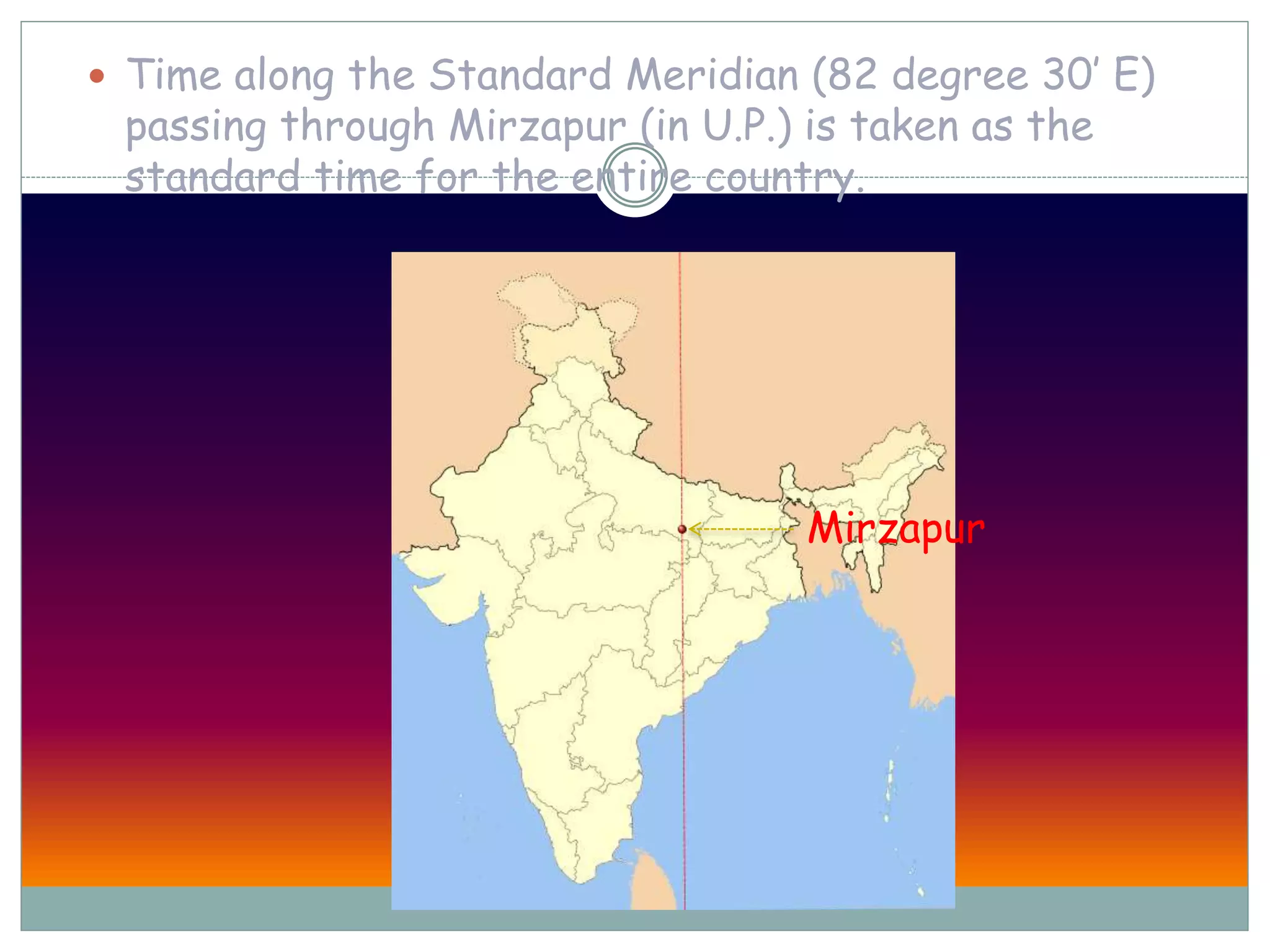
Image credit: Slideshare educational presentation via search, showing India map with standard meridian (82°30'E) passing through Mirzapur and extent lines.
- Western extreme: Guhar Moti (Kutch, Gujarat) — latest local sunrise/sunset.
- Eastern extreme: Kibithu (Arunachal Pradesh) — earliest local sunrise.
- No direct Salem/TN link (southern, average IST alignment), but TN follows IST uniformly; Salem clocks synchronized nationwide.
9. Flowchart Summary Longitudinal Extent (~29°) ? Solar Time Variation (~2 hours east-west) ? Eastern early sunrise, Western late ? Administrative need for uniformity ? Single Standard Meridian (82°30'E, Mirzapur) ? IST (UTC+5:30) nationwide ? Time Lag Paradox: Daylight differs, clocks same.
10. Ultra-Short Exam Capsule
- ~29° long extent ? ~2-hour time lag.
- IST: UTC+5:30 at 82°30'E (Mirzapur).
- Single zone for unity.
- Arunachal: Earliest sunrise.
- Gujarat: Latest sunset.
- No DST in India.
TYPE 2: QUICK REVISION & EXAM TRICKS
1. Highlights & Tricky Points
- Key: Single zone despite 2-hour lag — unity over local solar time.
- Trap: Examiners ask "why single zone" — answer: administrative uniformity, not geography.
- Trap: Exact calculation: 29° × 4 min = 116 min (not 120 min round-off).
- Trap: Confuse with Nepal (+5:45) — India fixed +5:30.
2. Memory Aids/Mnemonics
- Meridian: "82°30' Mirzapur — 82 is UP code, 30 minutes half-hour IST".
- Time lag: "East Early Arunachal (EEA), West Late Gujarat (WLG)".
- Paradox: "Clocks Same, Sun Different — CSSD" (Clocks Same Sun Differs).
- Eastern advantage: "Arunachal Awake First" (AAF).
3. Confusing Concepts
- Local Solar Time vs IST: Local varies by longitude (Sun position); IST fixed (clock-based).
- East: Local ahead ? early sunrise.
- West: Local behind ? late sunrise.
- Multiple Zones vs Single: Multiple for large countries (reduce variation); India single for simplicity (despite variation).
TYPE 3: PYQs & EXPECTED QUESTIONS
1. PYQ Vault
- UPSC Prelims 2014: The standard time of a country is decided by its? ? Central meridian.
- SSC CGL 2017: Indian Standard Time is ahead of Greenwich Mean Time by? ? 5 hours 30 minutes.
- RRB NTPC 2016: The longitude which passes through Mirzapur is? ? 82°30'E.
- SSC CGL 2020: Why does India have only one standard time? ? To maintain uniformity.
- UPSC Prelims 2019: The time difference between Gujarat and Arunachal Pradesh is approximately? ? 2 hours.
- TNPSC 2021: The meridian on which IST is based passes through which place? ? Mirzapur.
- SSC CGL 2018: India does not observe daylight saving time because? ? Single time zone policy.
- RRB JE 2022: The approximate time difference across India’s longitudinal extent is? ? 2 hours.
- BPSC 2020: Which state experiences the earliest sunrise in India? ? Arunachal Pradesh.
- SSC MTS 2019: The reference longitude for IST is? ? 82°30'E.
2. 2026 Expected Questions
- What is the standard meridian longitude for Indian Standard Time?
- Explain why India has a single time zone despite a significant longitudinal extent.
- Which location in Uttar Pradesh serves as the reference for IST?
- What is the approximate sunrise time difference between Arunachal Pradesh and Gujarat?
- Why has India not implemented daylight saving time or multiple time zones?
- How does the time lag paradox affect daily life in eastern and western India?